
Look at almost any world map and something strange happens. Greenland appears enormous. Europe looks impressively vast. North America seems gigantic.
And then there’s Africa.
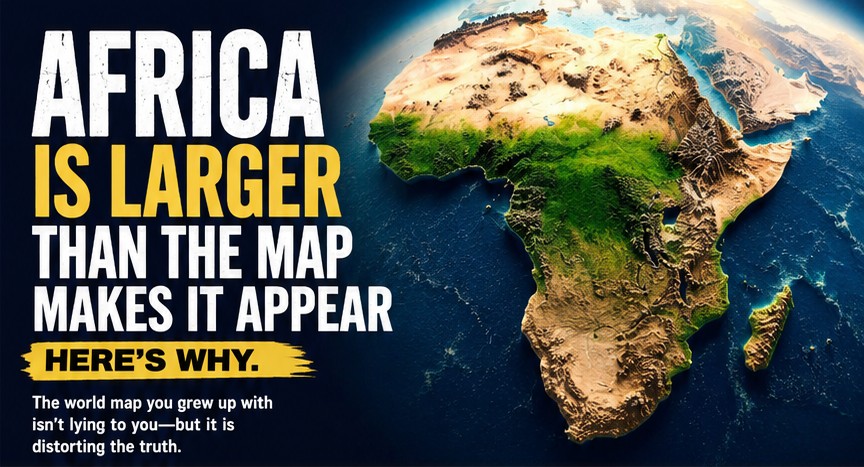
Despite being the world’s second-largest continent, Africa often appears surprisingly small on the maps hanging in classrooms, printed in textbooks, and displayed across the internet. For generations, this visual illusion has shaped how people see the continent.
Related Posts


The truth, however, is astonishing.
Africa is far larger than most people realize—so large that many countries and continents that appear similar in size on a map could fit inside it. The map isn’t necessarily lying, but it is definitely distorting reality.
Once you understand why, you’ll never look at a world map the same way again.
The Cartographic Trick Hiding Africa’s True Size
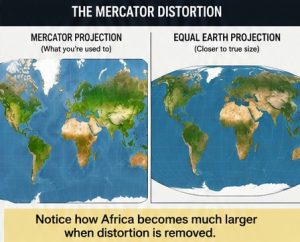
The reason Africa looks smaller than it really is can be traced back to a map-making technique known as the Mercator Projection.
Created in 1569 by Flemish cartographer Gerardus Mercator, the projection was revolutionary for navigation. It allowed sailors to plot straight-line courses across oceans, making long-distance sea travel much easier.
But there was a catch.
The Mercator Projection sacrifices size accuracy in order to preserve direction and shape. As a result, landmasses become increasingly stretched as they move farther from the equator.
Countries near the poles, such as Greenland, Canada, and Russia, appear much larger than they really are. Meanwhile, regions near the equator—including Africa—appear significantly smaller than their true size.
This distortion isn’t immediately obvious because most people have spent their entire lives looking at maps drawn this way. The illusion becomes normal.
Yet when the distortion is removed, the difference is staggering.
Africa’s Mind-Blowing Real Size
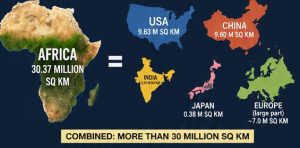
Africa covers approximately 30.37 million square kilometers (11.7 million square miles).
That number alone may not mean much until you compare it with other places.
The entire United States, China, India, Japan, and most of Europe could fit inside Africa—with room to spare.
Let that sink in for a moment.
Many people assume Europe is roughly comparable in size because of how it appears on a map. In reality, Africa is about three times larger than Europe.
Greenland provides another dramatic example. On a Mercator map, Greenland often appears nearly the same size as Africa.
But Greenland’s actual area is about 2.16 million square kilometers.
Africa?
More than 30 million square kilometers.
That means Africa is roughly 14 times larger than Greenland, even though standard maps often make them appear similar.
How Map Distortion Shapes Perception
Maps do more than show geography.
They influence how we think about the world.
When entire generations repeatedly see Africa represented as smaller than it truly is, it subtly affects perceptions of its importance, influence, resources, and potential.
Africa is home to over 1.5 billion people, thousands of languages, vast natural resources, rapidly growing economies, and some of the world’s youngest populations.
Why Does Everyone Seem to Have Nigerian DNA? The Fascinating Truth Behind Human Ancestry
Yet the visual impression created by distorted maps can unintentionally minimize the continent’s true scale and significance.
The issue isn’t just about geography. It’s about perspective.
A continent that occupies more than 20% of the Earth’s land area deserves to be seen for what it really is: one of the most massive and influential regions on the planet.
The Maps We Use Are Finally Changing
In recent years, educators, geographers, and scientists have increasingly embraced alternative map projections that better represent the true sizes of continents.
Maps such as the Equal Earth Projection and Gall-Peters Projection attempt to reduce the distortions that have long exaggerated northern regions while shrinking equatorial areas.
When people first see these maps, the reaction is often disbelief.
Africa suddenly looks enormous. Because it is. The continent hasn’t grown. The map has simply become more honest.
The Bigger Lesson
The story of Africa’s size is a reminder that what we see isn’t always reality.
For centuries, one of the world’s most widely used maps has quietly distorted our understanding of the planet. It made some regions appear larger and more dominant while making others seem smaller than they truly are.
Africa has always been immense. The maps simply failed to show it. So the next time you glance at a world map, remember this remarkable fact:
Africa is not small. The map is.
And once you see the continent at its true scale, it’s impossible to unsee just how extraordinary it really is.