
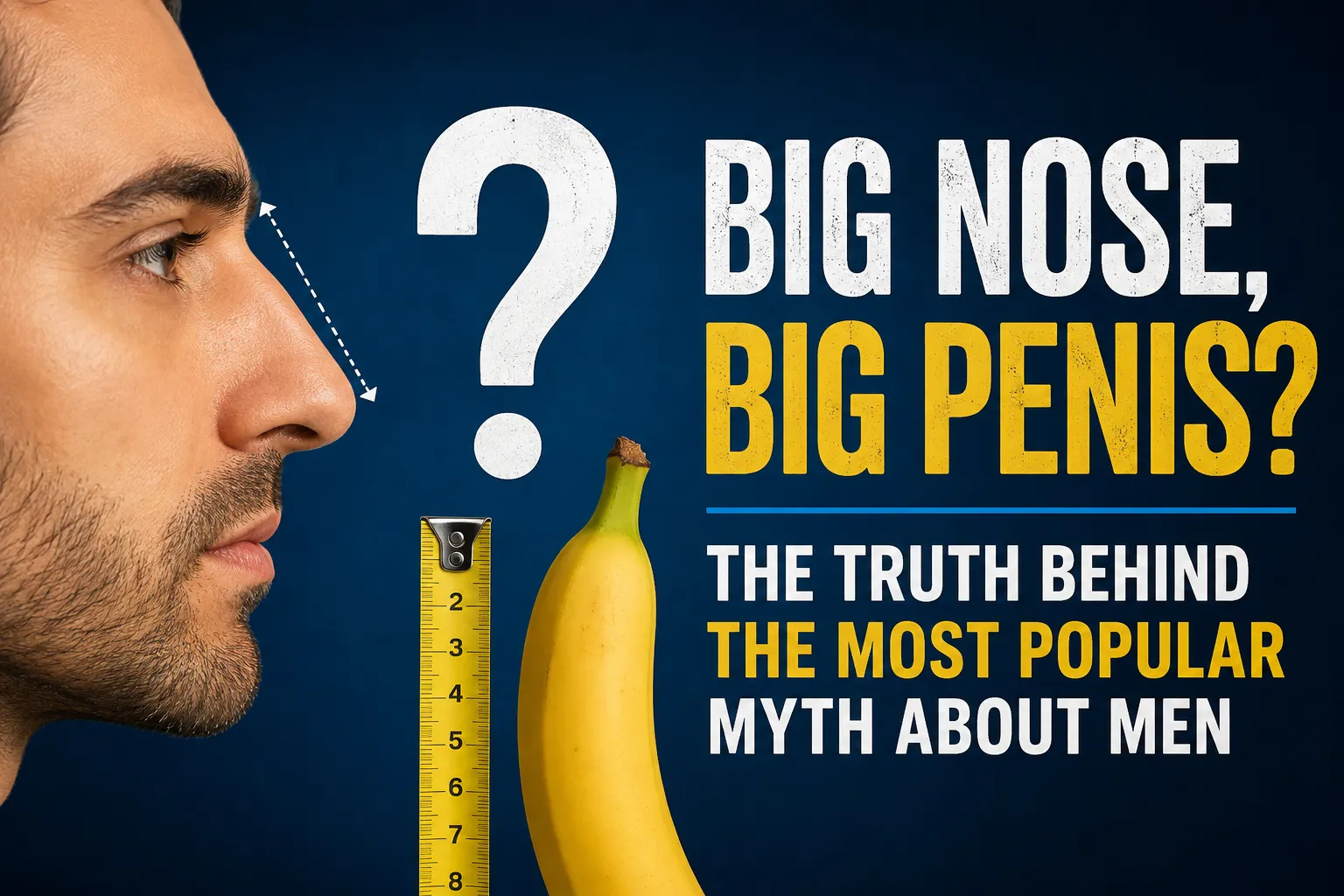

For generations, people have repeated a curious claim about the male body:
Does a man’s nose reveal the size of his penis?
It is the kind of question that can quickly turn into a joke, a conversation starter or an internet myth. Some people insist that men with larger noses must also have larger penises, while others claim that certain facial features can somehow reveal what a person is like physically.
Related Posts




But is there actually any science behind the idea?
The short answer is: not in any reliable way.
And the real story is more interesting than the myth itself.
Where Did the Idea Come From?
The belief that nose size can predict penis size is an old popular myth.
Like many physical “body-reading” claims, it probably became popular because humans naturally look for connections between visible characteristics and characteristics that cannot normally be observed.
We do this all the time.
Someone may assume that a tall person is stronger, that a person with large hands must be exceptionally athletic, or that certain facial features reveal personality.
Sometimes there may be a statistical relationship between two physical characteristics.
But that doesn’t mean one feature can reliably tell you what another person’s body is like.
That’s an important distinction.
Is There Any Scientific Evidence?
Researchers have investigated whether certain body measurements are associated with others.
Some studies have reported statistical associations between nose dimensions and genital measurements in particular groups of adult men.
However, this is very different from saying:
“A man with a large nose will have a large penis.”
A statistical association does not make one measurement a reliable predictor of another for an individual person.
There can be considerable variation from person to person.
In other words, even if researchers find that two characteristics show some relationship within a particular study population, you cannot look at someone’s nose and accurately determine their penis size.
Why Might Researchers Find a Relationship at All?
This is where biology becomes interesting.
Many physical characteristics are influenced by genetics, hormones and development.
Some researchers have investigated whether body parts that develop under similar biological influences might show correlations with one another.
But human development is complicated.
Genes don’t work like a simple measuring tape.
A person’s physical characteristics are influenced by many different genetic and environmental factors, and those factors don’t necessarily affect every part of the body in the same way.
So even when scientists find a relationship between two measurements, it doesn’t mean that one body part determines the other.
A Correlation Doesn’t Mean You Can “Read” Someone’s Body
Imagine researchers measured thousands of people and discovered that taller people, on average, had slightly larger feet.
That wouldn’t mean you could look at someone’s shoes and accurately determine their height.
There would still be plenty of exceptions.
The same principle applies to claims about nose size.
Even if a study finds some correlation between two measurements, the variation between individuals can be large.
This is one of the most commonly misunderstood ideas in science:
Correlation does not equal prediction.
What About Hands and Feet?
You’ve probably heard other versions of the same myth.
Why Does Everyone Seem to Have Nigerian DNA? The Fascinating Truth Behind Human Ancestry
Some people say that a man’s hand size, foot size or height can reveal his penis size.
These claims are repeated so often that they can sound like established facts.
But there is no simple body-part formula that allows someone to accurately determine another person’s genital size by looking at their hands, feet, nose or other visible features.
Human bodies simply don’t work that neatly.
Why Do These Myths Survive?
There’s a psychological reason these claims are so entertaining.
Humans love patterns.
If two things appear to occur together a few times, we naturally begin looking for a connection.
Suppose someone knows three tall men who also happen to have large feet.
They may begin to believe:
“Tall people must have large feet.”
The problem is that personal observations aren’t enough to establish a scientific rule.
The same thing happens with the nose-size myth.
A few memorable examples can make a claim feel true even when the evidence isn’t strong enough to support it.
The Brain Also Loves Simple Answers
There’s another reason these myths spread.
People prefer simple explanations.
It’s much easier to say:
“You can tell by looking at someone’s nose.”
than to explain that human anatomy is influenced by a complex combination of genetics, hormones, development and individual variation.
Simple claims are memorable.
They are also easy to repeat.
And once something has been repeated for generations, people can start assuming it must have some scientific basis.
But repetition doesn’t turn a myth into a fact.
So, Can You Tell From a Man’s Nose?
No, not reliably.
A person’s nose size, shape or appearance cannot be used as a dependable way to determine the size of their penis.
There may be scientific studies investigating relationships between different body measurements, but these findings should not be turned into a simple rule for judging individuals.
A person’s body is far more complicated than that.
The Bigger Lesson Behind the Myth
Interestingly, the nose-and-penis question reveals something much bigger about how we understand the human body.
We often assume that visible features tell us more than they actually do.
Height, facial features, hand size, hair, skin and other characteristics can tell us certain things about biology and development.
But they cannot provide a complete picture of another person’s body.
Two people can look remarkably similar while having significant differences in many other physical characteristics.
That’s normal human variation.
So the Next Time Someone Says “Big Nose, Big…”
You now know what to say.
It’s a popular myth, not a reliable measuring system.
There may be scientific research exploring statistical relationships between different body measurements, but that doesn’t mean you can examine someone’s face and accurately predict their anatomy.
Human biology is simply too complex for that.
And perhaps that’s the most interesting answer of all:
You can’t judge what is underneath the surface simply by looking at what’s visible.
The Bottom Line
Does a man’s nose indicate the size of his penis?
No. Not in any reliable, individual sense.
While researchers have explored correlations between different physical measurements, nose size is not a dependable predictor of genital size.
So the next time you hear someone confidently making the claim, remember:
A big nose doesn’t come with a biological guarantee.
What Do You Think?
Have you heard the “big nose, big…” claim before?
Do you think it is one of those myths that became popular simply because people kept repeating it?
Share your thoughts in the comments.