
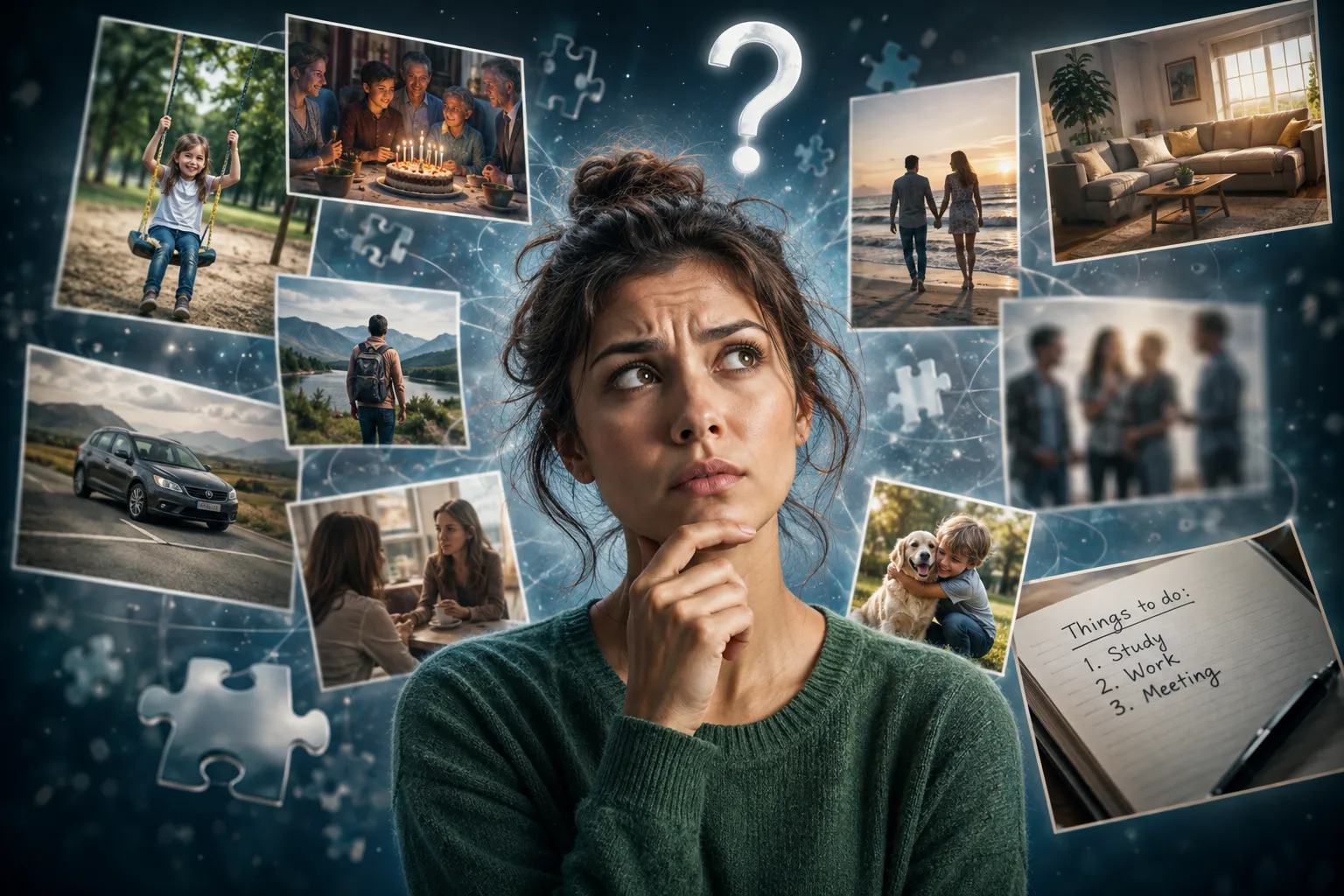

Have you ever been completely certain that something happened—only to discover later that it never actually did?
Perhaps you remember having a conversation with someone, but they insist it never happened. Maybe you clearly remember seeing a particular photograph, visiting a particular place, or hearing someone say something, only to find out that your memory doesn’t match reality.
The strange part is that you may not be lying.
Related Posts




You may genuinely believe the memory is real.
That’s because human memory isn’t a perfect recording of the past. Your brain does something much more complicated: it reconstructs memories.
And sometimes, that reconstruction can produce a memory of something that never actually happened.
Your Brain Isn’t a Video Camera
It is tempting to imagine memory as a recording.
Something happens. Your brain supposedly stores it. Later, you simply “play it back.”
But that’s not how human memory works.
When you remember an event, your brain doesn’t retrieve a perfect recording of what happened. Instead, it reconstructs the experience using pieces of information stored in different parts of the brain.
Those pieces can include:
- What you actually saw
- What you heard
- What you felt
- What you expected to happen
- Information you learned later
- Other people’s accounts
- Your existing knowledge and assumptions
Most of the time, this reconstruction works remarkably well.
But occasionally, the pieces don’t fit together exactly as they originally did.
And that’s when memory can become surprisingly unreliable.
So How Can You Remember Something That Never Happened?
Imagine that your friend tells you about a party you didn’t attend.
They describe the house, the people who were there, the music playing and something funny that happened.
Always Do These 4 Things Before You Agree to Go on a Date
A few weeks later, someone asks whether you remember the party.
You might begin to imagine what it looked like.
Over time, the imagined details can become increasingly familiar.
Eventually, your brain may have difficulty distinguishing between something you actually experienced and something you repeatedly imagined or heard about.
You could end up thinking:
“I remember being there.”
But you weren’t.
The memory feels real because the brain is not simply asking, “Did this physically happen to me?”
It is reconstructing what seems familiar based on the information available to it.
The Strange Phenomenon Is Called a False Memory
Psychologists use the term false memory to describe a recollection of something that did not happen as remembered—or, in some cases, did not happen at all.
False memories aren’t necessarily deliberate lies.
A person can be completely sincere while describing something that is inaccurate.
That’s what makes them so fascinating.
Someone can confidently say:
“I know this happened. I remember it clearly.”
And yet their memory can still be wrong.
In fact, confidence and accuracy are not always the same thing.
A person can become extremely confident in a memory simply because they have thought about it many times.
Repeating a Story Can Actually Change Your Memory
Here’s where things get even more interesting.
Every time you remember something, you aren’t necessarily retrieving an untouched copy of the original memory.
The act of remembering can involve reconstructing the event again.
That means memories can gradually change.
Suppose you witnessed a minor accident.
Immediately afterward, you remember seeing a red car.
Later, someone tells you they thought the car was blue.
You hear the story again from another person.
Months later, you may remember seeing a blue car.
You haven’t intentionally changed your story.
Your memory has simply been influenced by information encountered after the original event.
This is one reason eyewitness testimony can sometimes be less reliable than people assume.
Your Brain Fills In Missing Information
The brain is constantly trying to make sense of incomplete information.
This is useful.
Imagine seeing someone walking into a room wearing a coat.
You don’t need to consciously think:
“That person probably has a body underneath the coat.”
Your brain automatically fills in information.
Memory works in a similar way.
If you remember the general structure of an event but have forgotten some details, your brain may fill in the gaps using what seems reasonable.
The result can feel like a complete memory—even though parts of it have been reconstructed.
Emotion Can Make Memories Feel Stronger—but Not Necessarily More Accurate
You might assume that emotional events are always remembered perfectly.
Not necessarily.
Strong emotions can make an experience feel extremely memorable.
You might vividly remember where you were when you received shocking news, for example.
But vividness doesn’t guarantee that every detail is correct.
You might accurately remember the general event while getting smaller details wrong.
This is because memory has different components.
You can remember the feeling of an event very strongly while misremembering exactly what was said, who was present, or when something happened.
Why Do Embarrassing Memories Stay With Us?
Think about something embarrassing you did years ago.
You might still remember exactly how you felt.
But ask yourself:
Do you actually remember everything exactly as it happened—or have you replayed the event in your mind so many times that your current version is partly reconstructed?
Repeatedly thinking about an event can strengthen your familiarity with the memory.
But repetition doesn’t necessarily guarantee perfect accuracy.
In some cases, the version you repeatedly imagine can gradually become the version you remember.
Other People’s Memories Can Influence Yours
This becomes especially interesting when several people remember the same event.
Imagine five friends attend a concert.
One person later says:
“Remember when the singer fell?”
Another replies:
“Yes! Everyone started laughing.”
Someone else joins the conversation and says:
“I remember the microphone nearly hitting him.”
Eventually, everyone has heard several versions of the story.
Years later, each person may remember details that came from the group conversation rather than from their own original experience.
This is sometimes called memory conformity—when people’s recollections become influenced by the memories reported by others.
Social Media Could Make This Even More Complicated
Today, we don’t just remember our own experiences.
We constantly see photographs, videos, posts and other people’s accounts of events.
That creates an unusual situation.
You might attend an event and later see hundreds of photographs from it online.
Over time, you may remember details from those photographs as though they were part of your original visual memory.
You may even forget whether you personally saw something or simply saw someone else’s picture of it.
Our digital world gives us an enormous amount of information that can become mixed with our own memories.
What About Childhood Memories?
Childhood memories can be particularly fascinating.
Many people have vivid memories from when they were very young.
But human memory develops over time, and our earliest memories may not be as reliable as they feel.
Some memories can also be influenced by photographs, family stories and repeated conversations.
Imagine your parents repeatedly telling you:
“You were terrified of the dog when you were three.”
Eventually, you might develop a mental picture of that event.
You may even feel as though you can remember it.
But how much of the memory comes from your actual experience, and how much comes from hearing the story repeatedly?
Sometimes, it can be difficult to tell.
Can You Create a Completely False Memory?
Researchers have demonstrated that memories can sometimes be influenced by suggestion.
In carefully controlled psychological experiments, participants have sometimes come to remember events differently after receiving misleading information or suggestions.
This doesn’t mean that someone can simply tell you anything and instantly make you believe it.
Human memory is much more complicated than that.
But it demonstrates something important:
Memory is not completely fixed.
Information we encounter after an event can sometimes affect how we remember the event later.
Does This Mean You Can’t Trust Your Memories?
Not at all.
The fact that memory can be inaccurate doesn’t mean that everything you remember is false.
Your memory is an incredibly powerful system.
It allows you to recognise people, learn skills, remember experiences, navigate familiar places and build a sense of personal identity.
Most everyday memories are useful enough for us to function normally.
The important point is simply that memory is not a perfect historical record.
Some memories are highly accurate.
Others contain small errors.
And occasionally, people can become convinced that something happened when it did not.
The Strangest Part: A False Memory Can Feel Completely Real
This may be the most unsettling thing about false memories.
If someone says:
“Are you sure that happened?”
you might confidently answer:
“Absolutely. I remember it.”
The problem is that the feeling of remembering something doesn’t automatically prove that the memory is accurate.
Your brain doesn’t attach a little label saying:
REAL
or
FALSE
to every memory.
Instead, it reconstructs experiences and gives you a sense of familiarity and recollection.
That system is extraordinarily useful—but it isn’t perfect.
Why Would the Brain Work This Way?
There is an important reason.
The brain isn’t primarily designed to preserve a perfect historical record of your life.
It is designed to help you function, learn and make decisions.
Remembering the important meaning of an experience can often be more useful than remembering every tiny detail.
If you meet a dangerous animal, for example, your brain doesn’t necessarily need to preserve a perfect frame-by-frame recording.
It needs to remember something much more useful:
“That animal was dangerous. Stay away from it.”
Memory therefore prioritises usefulness rather than perfect archival accuracy.
Your Memory Is More Like a Story Than a Recording
Perhaps the best way to think about human memory is this:
Your brain is not replaying the past. It is rebuilding it.
Every time you remember something, your brain brings together fragments of information and reconstructs an account of what happened.
Usually, the result is close enough to reality.
But sometimes, the reconstruction contains details that weren’t actually there.
And that’s how you can end up remembering something that never happened.
So the Next Time You’re Absolutely Certain You Remember Something…
Pause for a moment.
Ask yourself:
Did I actually experience this, or have I heard the story many times?
Could someone else’s account have influenced my memory?
Have I seen photographs or videos of the event?
Have I repeatedly imagined what happened?
Am I remembering the event itself—or simply remembering the story I have told myself about it?
You might discover something surprising.
The human brain is capable of remembering the past with remarkable detail.
But sometimes, the memory you are most confident about isn’t necessarily the memory that is most accurate.
And perhaps that’s the strangest thing about memory of all.
Your brain can make you remember something that never happened—and make the memory feel completely real.
🔎 Did You Know?
A memory feeling vivid, emotional or extremely familiar does not automatically mean every detail of it is accurate. Memory researchers distinguish between how confident someone feels about a memory and how accurately the memory corresponds to what actually happened.
What Do You Think?
Have you ever been completely certain that something happened, only for someone else to tell you that it never did?
Tell us about your experience in the comments.