



Artificial intelligence is transforming the world. From ChatGPT answering everyday questions to AI-powered systems helping doctors, businesses, researchers and students, the technology is becoming an increasingly important part of modern life.
But behind the convenience of asking an AI chatbot a question, generating an image or producing a report lies an environmental cost that many people rarely consider: water.
While much of the conversation about artificial intelligence focuses on electricity consumption and carbon emissions, another resource is quietly becoming a major concern. Freshwater.




The computers powering artificial intelligence need enormous amounts of electricity and generate significant heat. To keep these machines operating safely, the data centres housing them require sophisticated cooling systems. Depending on the technology used, some of these facilities consume substantial quantities of freshwater.
And the concern is growing as technology companies race to build more powerful AI systems and expand their data centre infrastructure.
So, is artificial intelligence consuming all the world’s clean water? Is our growing dependence on AI putting additional pressure on an already strained global water supply?
The answer is more complicated than the headlines suggest. However, the environmental implications are serious enough to deserve attention.
How Does Artificial Intelligence Use Water?
To understand the problem, it is important to understand where artificial intelligence actually operates.
AI systems do not exist entirely in the cloud. Behind every chatbot, image generator and AI-powered application are physical computers housed in enormous facilities known as data centres.
These facilities contain thousands of powerful computer servers that process information, store data and run complex calculations.
Unlike ordinary office computers, the high-performance processors used to train and operate advanced AI models can generate considerable heat, particularly when thousands of them work simultaneously.
If the temperature becomes too high, the equipment can become less efficient or suffer damage. Consequently, data centres need reliable cooling systems to maintain suitable operating temperatures.
This is where water enters the picture.

Behind every AI response is a network of powerful computers operating inside massive data centres.
Many data centres use cooling towers and evaporative cooling systems. These systems remove heat by allowing some water to evaporate. The process helps lower temperatures, but the evaporated water must be replaced.
In some facilities, this means continuously drawing fresh water from municipal supplies, rivers, reservoirs or other sources.
It is important to understand that not every data centre uses the same cooling technology. Some rely on air cooling, closed-loop liquid cooling, recycled water or other systems that significantly reduce their dependence on freshwater.
Nevertheless, water remains an important part of the environmental footprint of many computing facilities.
AI Does Not Just Use Water to Cool Computers
One of the biggest misconceptions about AI’s water consumption is that the only water involved is the water used inside data centres.
In reality, its water footprint extends beyond the buildings themselves. There are three major ways artificial intelligence contributes to water consumption.
1. Direct water consumption through data centre cooling
This is perhaps the easiest part of the problem to understand.
AI servers generate heat, and some facilities use water-based cooling systems to remove it. When evaporative cooling is used, some of the water disappears into the atmosphere and cannot immediately be reused within the same local water system.
The larger the computing operation, the greater the potential cooling demand. A large AI data centre operating continuously can therefore place considerable demand on the water resources of the area where it is located.
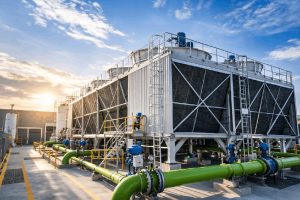
Some data centre cooling systems use evaporative cooling, which consumes water as heat is released into the atmosphere.
2. Indirect water consumption through electricity generation
Artificial intelligence requires enormous computing power, and that computing power requires electricity. However, generating electricity can also consume water.
Some thermal power stations use water for cooling, while certain forms of electricity generation have their own water requirements.
This means that even when a data centre does not use much water directly, the electricity powering its servers may have an additional water footprint elsewhere.
In other words, the environmental cost of running an AI system is not limited to the water flowing through the cooling equipment inside its data centre.
According to the International Energy Agency’s Energy and AI report, global data centres consumed approximately 560 billion litres of water in 2023. The IEA estimates that this could rise to approximately 1.2 trillion litres annually by 2030 under its base-case projection.
These figures cover data centres generally, not AI alone.
Where Does the Internet Actually Live?
The IEA also explains that electricity generation and energy supply account for a substantial proportion of data centre water consumption.
This demonstrates why assessing only the water used inside data centres gives an incomplete picture.
3. Water used in manufacturing computer chips
There is another part of the story that receives even less attention. The advanced processors used in artificial intelligence systems must first be manufactured.
Producing semiconductor chips is an extremely complex industrial process involving highly purified water, often referred to as ultrapure water.
This water is used in cleaning and rinsing processes during chip manufacturing because even tiny particles or contaminants can affect the performance of semiconductor components.
As demand for AI processors increases, the semiconductor industry must produce more advanced computing hardware.
This creates an additional water demand throughout the technology supply chain.
Therefore, the water footprint of AI begins long before someone opens ChatGPT and types their first question.
How Much Water Does ChatGPT Actually Consume?
This is where the subject becomes particularly interesting.
In 2025, researchers Pengfei Li, Jianyi Yang, Mohammad A. Islam and Shaolei Ren published a research paper titled Making AI Less ‘Thirsty’: Uncovering and Addressing the Secret Water Footprint of AI Models in Communications of the ACM.
The researchers examined the water footprint associated with training and operating large language models.
One of their estimates suggested that training GPT-3, a large language model developed by OpenAI, in Microsoft’s US data centres could consume approximately 5.4 million litres of water in total when direct and indirect water consumption were included.
Of this amount, approximately 700,000 litres represented direct, onsite water consumption.
The researchers also estimated that approximately 500 millilitres of water could be consumed for every 10 to 50 medium-length responses generated by GPT-3, depending on the location and operating conditions.
However, this should not be interpreted as a fixed measurement for every ChatGPT conversation.
Different AI models have different computing requirements. The length and complexity of a request, the hardware being used, the cooling system, the local climate and the electricity source can all influence the result.
A short text response is not environmentally equivalent to generating a complex image or processing a lengthy AI task.
The important point is that AI interactions have an infrastructure cost, even when the technology appears to operate effortlessly on a smartphone or laptop.
You can read the original research in Communications of the ACM.
Could AI Consume Billions of Litres of Water in the Coming Years?
The concern becomes even greater when we consider how quickly artificial intelligence is expanding.
Technology companies are investing billions of dollars in new data centres, advanced processors and computing infrastructure to support increasingly powerful AI systems.
As more people and businesses adopt AI, the demand for computing resources is expected to increase.
A widely cited projection by Li and colleagues estimated that global AI-related water withdrawal could reach between 4.2 billion and 6.6 billion cubic metres annually by 2027.
To understand the scale, one cubic metre contains 1,000 litres of water.
That projection therefore represents between 4.2 trillion and 6.6 trillion litres of water withdrawals annually.
It is important to distinguish between water withdrawal and water consumption.
-
Water withdrawal: The total amount of water taken from sources such as rivers, lakes and groundwater. Some of this water may eventually be returned.
-
Water consumption: The portion that is not returned to the original water source in a readily reusable form, for example because it has evaporated.
The same research estimated that approximately 380–600 billion litres could be consumed through evaporation associated with global AI demand in 2027.
These figures are projections, not confirmation that this quantity has already been consumed or that it will necessarily be reached.
Nevertheless, they highlight the potential scale of the challenge if AI infrastructure continues expanding without sufficient attention to water efficiency.
Why Should We Be Worried When Millions of People Already Lack Clean Water?
The most important question is not simply how much water artificial intelligence uses.
It is where that water is being used.
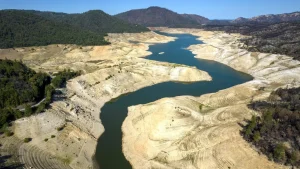
Water scarcity remains a serious challenge in communities around the world, making the location of water-intensive industries particularly important.
Water is not distributed equally across the world. Some regions have abundant freshwater resources, while others experience prolonged droughts, unreliable rainfall, groundwater depletion and serious water shortages.
A data centre located in a water-rich region may have a very different environmental impact from one operating in an area already experiencing severe water stress. This is why the location of AI infrastructure matters.
When a large data centre is constructed in an area experiencing water shortages, its demand for water can create additional pressure on existing resources.
Local residents, farmers, businesses and other industries may depend on the same water supplies.
This does not automatically mean that a data centre will deprive nearby residents of drinking water. The actual impact depends on its water source, consumption levels, local infrastructure, environmental regulations and how water resources are managed.
However, the potential for competition over limited freshwater resources is a legitimate concern. In countries where access to clean drinking water is already a major development challenge, the expansion of water-intensive industries deserves particularly careful planning.
It would be difficult to justify technological progress that places unnecessary pressure on communities struggling to secure reliable access to essential water supplies.
Are Technology Companies Doing Anything About It?
The growing environmental impact of data centres has not gone unnoticed by major technology companies.
Microsoft, Google and other technology businesses have announced sustainability commitments and investments aimed at reducing the environmental impact of their infrastructure.
Some of the approaches include:
Water-efficient cooling systems: Companies are exploring cooling technologies that reduce or eliminate the need for continuous freshwater evaporation.
Closed-loop liquid cooling: Instead of constantly consuming new water, these systems circulate coolant through equipment to remove heat. Depending on their design, they can significantly reduce ongoing water demand.
Recycled and reclaimed water: Some facilities use treated wastewater or recycled water rather than relying entirely on drinking-quality freshwater.
Improved data centre locations: Building facilities in cooler climates or areas with more sustainable water resources can reduce cooling requirements and local environmental pressure.
More efficient AI hardware: Developing processors that deliver more computing performance with less electricity can also reduce the amount of heat that needs to be removed.
Microsoft, for example, announced a new data centre design in 2024 intended to use zero water for cooling. The company stated that its chip-level cooling approach could save more than 125,000 cubic metres of water annually per data centre compared with its previous average water-use performance.
Its reported global data centre water usage effectiveness also improved from 0.30 litres per kilowatt-hour in FY2024 to 0.27 litres per kilowatt-hour in FY2025.
These developments are encouraging, but they do not mean that the entire technology industry has eliminated its water footprint.
The electricity supply, semiconductor manufacturing, construction and other parts of the supply chain still have environmental consequences.
Furthermore, sustainability commitments need to be supported by transparent reporting and independently verifiable results.
You can examine Microsoft’s figures in its data centre energy and water efficiency report and its 2025 Environmental Sustainability Report.
Is AI Really Worth the Environmental Cost?
This is perhaps the most difficult question.
Artificial intelligence has enormous potential to improve people’s lives.
It can support medical research, assist scientists in analysing complex information, help farmers make better decisions, improve transport systems and make education more accessible.
It is also helping businesses automate repetitive tasks and enabling researchers to explore solutions to environmental problems.
However, the benefits of AI do not automatically justify unlimited consumption of natural resources.
Not every AI application provides the same level of social value, and not every computing task requires the most powerful available model.
As AI becomes more deeply integrated into everyday life, technology companies must consider whether the benefits of particular applications justify their energy and water requirements. There is also a need to make environmental information more accessible to the public.
Consumers can see how quickly AI tools generate answers, but they rarely know which data centre processed their requests, how much electricity was required or what the associated water footprint might have been.
Without better transparency, it becomes difficult for regulators, researchers and communities to assess the true environmental cost of the technology.
What Can Be Done to Reduce AI’s Water Footprint?
Reducing AI’s water consumption should not mean abandoning technological progress.
Instead, it requires a more responsible approach to how AI systems are developed, powered and operated.
Several steps could make a meaningful difference:
1. Invest in water-efficient data centres. Technology companies should prioritise cooling systems that minimise freshwater consumption, particularly in areas experiencing water stress.
2. Increase the use of recycled water. Where appropriate and environmentally safe, treated wastewater can reduce dependence on freshwater supplies.
3. Improve electricity efficiency. More efficient processors, data centres and electricity systems can reduce the indirect water footprint associated with AI.
4. Avoid building water-intensive facilities in vulnerable regions. Companies and governments should assess local water availability before approving major data centre developments.
5. Make water consumption figures public. Technology companies should disclose meaningful information about their direct and indirect water consumption, rather than relying solely on broad corporate sustainability claims.
6. Develop more efficient AI models. Smaller, specialised models can sometimes perform particular tasks with fewer computing resources than much larger general-purpose systems.
Governments also have an important role to play by establishing environmental standards and ensuring that communities are considered when large technology projects are approved.
So, Is Artificial Intelligence Consuming All Our Clean Water?
No. Artificial intelligence is not consuming all the world’s clean water, and there is no credible evidence that it is about to leave humanity without freshwater.
However, dismissing the issue simply because the headline sounds exaggerated would be a mistake.
AI is creating a growing demand for computing infrastructure, and that infrastructure requires electricity, cooling and increasingly sophisticated hardware.
All three can contribute to freshwater consumption.
The greatest concern is not necessarily the total amount of water used by AI worldwide, but the pressure that large facilities could place on particular communities and water-stressed regions.
As the technology continues to advance, its environmental footprint must become part of the conversation about innovation.
The world cannot afford to pursue technological progress while ignoring the natural resources required to sustain it.
Artificial intelligence may be getting smarter every day, but the industry must also become smarter about how it uses the planet’s most essential resources.
The question is no longer just how powerful AI can become. It is whether we can make that progress without putting additional pressure on the water resources that people, communities and ecosystems depend on.