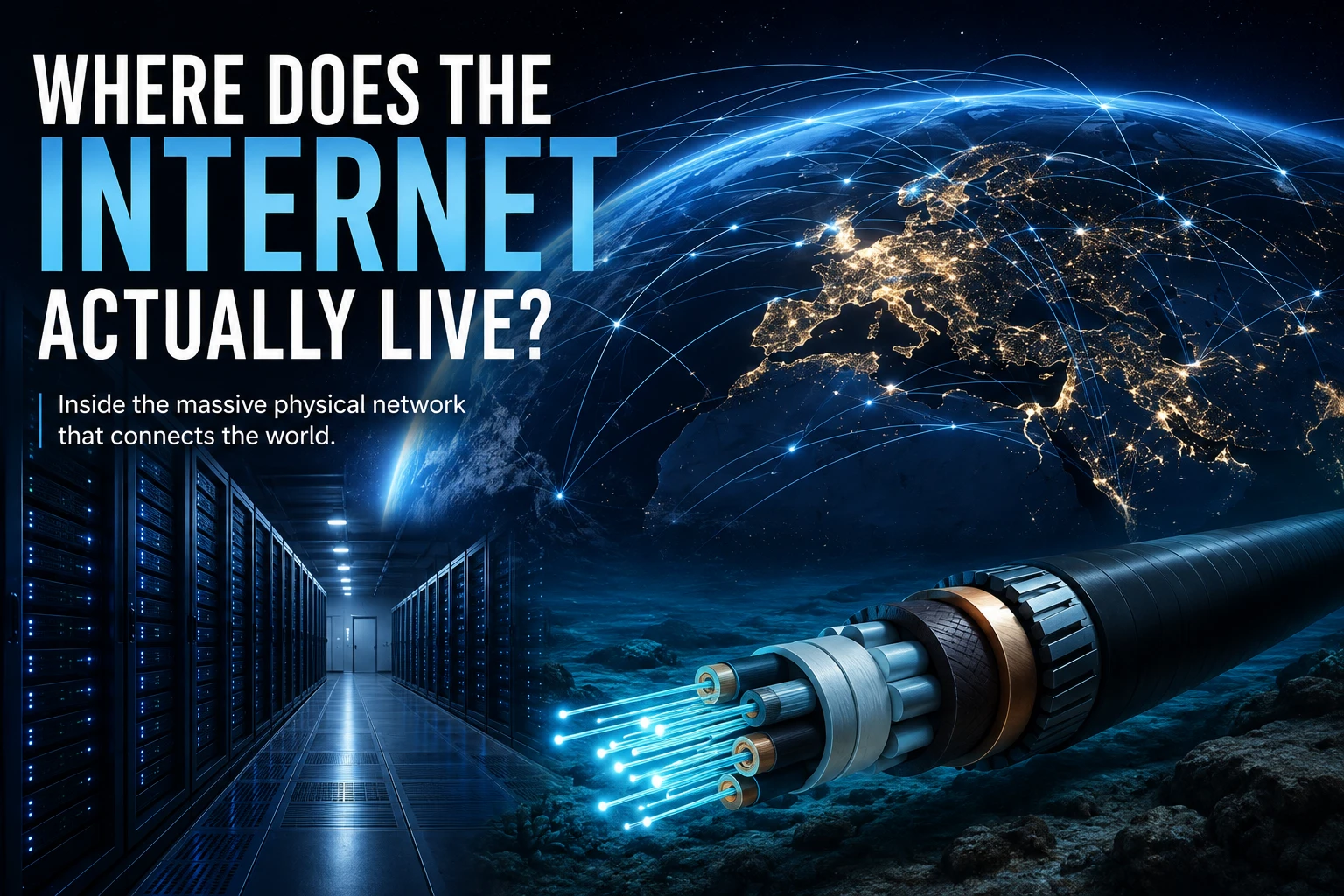

You use the internet every day, but have you ever stopped to wonder where it actually exists? When you open a website, send a WhatsApp message, watch a YouTube video, upload a photograph or search for something, the information appears on your screen almost instantly. It feels almost magical. There is no visible wire connecting your phone to someone else’s computer thousands of kilometres away, so it is easy to imagine that the internet is some invisible thing floating around us. We talk about “the cloud” as though our files and applications have been sent somewhere in the sky. But the reality is much more fascinating: the internet is an enormous physical machine spread across the planet.
There is no single place called “the internet.” Instead, the internet is a massive collection of interconnected networks. It is made up of millions of computers, servers, routers, switches, fibre-optic cables, mobile networks, data centres and other infrastructure operated by thousands of different organisations. Some of these machines sit inside heavily secured buildings, while some of the cables connecting them run underneath roads, through cities and across the floors of oceans. Every time you use the internet, your information is travelling through some combination of this physical infrastructure.
The Internet Doesn’t Have One Home
If you were given a plane ticket and told to visit “the internet,” you wouldn’t know where to go. There is no headquarters containing everything. Unlike a normal computer, the internet has no single processor, hard drive or central power switch. It is a distributed network in which countless independent networks communicate with one another.




This design is one of the reasons the internet is so resilient. If one computer stops working, another can often take over its job. If a network connection fails, traffic can sometimes be redirected through another route. If an undersea cable is damaged, operators may be able to move traffic onto other cables. The system isn’t immune to major failures, but it was never designed around the idea that every piece of infrastructure must remain operational at all times.
The Buildings That Contain Huge Pieces of the Internet
One of the most important physical locations in the internet is the data centre. A data centre is a facility designed to house large numbers of computer servers and networking equipment. These servers can run websites, store files, process databases, deliver videos, host applications and perform countless other tasks.
A modern data centre can contain thousands of computers operating continuously. But keeping those computers running is much more complicated than simply plugging them into a wall. Servers consume enormous amounts of electricity and generate substantial heat, so data centres require sophisticated cooling systems. They also need backup power, fire protection, physical security, monitoring systems and multiple network connections.
This is the physical reality behind the “cloud.” When you save a photograph to cloud storage, for example, the photograph hasn’t disappeared into some mysterious digital space. It is ultimately stored on physical storage systems somewhere inside a data centre.

A major online service may have data centres in several countries or even on several continents. This allows companies to serve users more efficiently and provides additional resilience if one location experiences a problem. Consequently, asking where a major website lives can have a much more complicated answer than simply naming one building.
The Secret Highways Beneath the Ocean
Perhaps the most surprising fact about the internet is that some of its most important infrastructure is hidden beneath the world’s oceans.
Thousands of kilometres of submarine communication cables connect continents. These cables are laid across the seabed and link countries and regions together. They are among the most important pieces of infrastructure supporting international digital communication.
Inside these cables are extremely thin strands of optical fibre. Information can be transmitted through them using pulses of light, allowing enormous quantities of digital data to travel over very long distances.
The cables eventually reach land at specialised facilities called cable landing stations. From there, the traffic enters terrestrial networks and can continue towards data centres, internet exchanges and other destinations.
So when you send a message to someone on another continent, there is a possibility that part of that message will physically travel beneath an ocean. The journey that feels completely invisible on your phone can involve thousands of kilometres of glass fibre sitting on the seabed.
What Actually Travels Through the Cables?
Your photograph, video or webpage isn’t normally sent through the internet as one enormous object. Digital information is divided into smaller pieces known as packets. These packets travel through networks and are eventually reassembled and processed by the receiving system.
Imagine sending a very large book through a postal system, except instead of putting the whole book into one enormous package, you divide it into thousands of smaller packages. Each package contains information that helps the receiving system understand where it belongs. Network equipment then helps move those packets towards their destination.
This process happens incredibly quickly. When you tap on a website, your request can pass through multiple pieces of networking equipment before reaching the system responsible for providing the webpage. The response then travels back through the network to your device.
Your Wi-Fi Isn’t the Whole Internet
There is another reason the internet can appear invisible: Wi-Fi. When your phone connects to your home Wi-Fi, it is communicating wirelessly with your router. But that wireless connection usually represents only a very small part of the entire journey.
Your router may connect to your internet service provider through fibre-optic cable, coaxial cable, telephone infrastructure, fixed wireless technology or another access system. From your provider’s network, the traffic can then travel into larger networks and potentially across international connections.
So the next time you sit on your sofa and watch a video using Wi-Fi, remember that the video isn’t necessarily travelling wirelessly all the way from another country to your phone. The first part of the journey may be wireless, but much of the rest could involve physical cables.
Routers Are the Traffic Directors
With enormous quantities of data travelling across the world simultaneously, the network needs a way to determine where each packet should go. That is where routers come in.
Routers are specialised networking devices that examine information associated with packets and forward them towards appropriate destinations. You can think of them as traffic directors for the digital world.
There isn’t necessarily one fixed route between your device and a server. Networks continuously exchange information about the routes they can reach. Depending on network conditions and available connections, traffic can sometimes be sent along different paths.
This is why the internet isn’t like a single road stretching from your house to a data centre. It is more like an enormous road network containing countless intersections, alternative routes, highways and local streets.
The Places Where Networks Meet
Another important part of the internet is the Internet Exchange Point, or IXP. These are physical locations where different networks can connect and exchange traffic.
Imagine several major roads meeting at a huge transport interchange. Instead of every vehicle having to travel through one central road, traffic can move directly between different routes. Internet exchange points perform a somewhat similar function for networks.
At these facilities, internet service providers, content networks and other organisations can connect their infrastructure and exchange traffic. This can make communication more efficient and reduce the distance that some information needs to travel.
So Where Does Your Favourite Website Live?
This question becomes surprisingly difficult when you’re talking about a major website.
A small website might be hosted on a particular server inside one data centre. But large online services can be distributed across many locations around the world. They may use multiple data centres, cloud infrastructure and content delivery networks to serve users.
This means that two people sitting in different countries could open what appears to be exactly the same website while actually communicating with completely different physical servers.
Your browser doesn’t need to know all of this. You simply enter a web address and receive the information. Behind the scenes, however, complex systems determine where your request should be handled.
What Happens When You Type a Website Address?
Suppose you type a website address into your browser. Your computer first needs to discover where that website can be reached. This is where the Domain Name System, or DNS, becomes important. DNS helps translate human-friendly domain names into IP addresses that computers can use for network communication.
Your device then establishes the necessary network connection and sends a request for the webpage. That request travels through your local network, your internet provider and potentially several other networks before reaching the appropriate infrastructure.
The server or service receives the request and sends information back. Your device receives the data, your browser processes it and the webpage appears on your screen.
The entire process can happen so quickly that you barely notice any of it.
What Happens If an Undersea Cable Breaks?
The internet’s dependence on physical cables becomes particularly obvious when those cables are damaged.
Submarine cables can be affected by activities such as fishing, ship anchors, geological events and other incidents. When a cable is damaged, network operators can sometimes reroute traffic through other available connections.
But alternative routes have limits. If too much traffic is redirected onto a smaller number of cables, congestion can occur. Users may experience slower speeds, increased latency or interruptions to particular services.
Repairing an undersea cable is also a major engineering operation. Specialised vessels may have to locate the damaged section, retrieve the cable, repair it and carefully return it to the seabed.
It is an extraordinary amount of work for infrastructure that most people never even realise exists.
Is the Internet Stored in the Cloud?
The word “cloud” makes the internet sound much more mysterious than it really is.
Cloud computing essentially allows people and organisations to access computing resources over a network rather than having to operate all of the necessary hardware themselves.
But the cloud still needs physical machines.
Your cloud photographs are stored somewhere. Your online documents are stored somewhere. The servers running your favourite online application are somewhere. The videos you stream are delivered from physical infrastructure somewhere.
The cloud is therefore not the opposite of physical computing.
The cloud is physical computing that you access remotely.
The Internet Is Much Bigger Than Your Screen
Perhaps the most amazing part of the internet is how little of its physical infrastructure we actually see.
You might be holding a smartphone that weighs only a few hundred grams, yet that small device can communicate with computers thousands of kilometres away. Behind a simple search query could be a chain of routers, fibre-optic cables, data centres, servers and network exchanges.
A message that takes you one second to send can involve infrastructure spread across cities, countries and potentially oceans.
The internet has therefore become almost invisible precisely because it works so well. We don’t see the cables. We don’t see the servers. We don’t see the routers deciding where our data should go. We simply see the final result on our screens.
So, Where Does the Internet Actually Live?
The answer is both simple and extraordinary.
It lives in data centres. It lives inside servers. It travels through fibre-optic cables buried beneath cities and stretched across countries. It crosses oceans through submarine cables. It passes through routers and switches. It moves between networks through internet exchange points. It reaches homes through internet service providers and finally arrives at the phones, computers and other devices we use every day.
The internet isn’t a single place.
It is a planet-sized system.
The next time you send a message, watch a video or open a website, remember that the experience may look completely digital, but the journey is remarkably physical. Your request could begin inside your phone, travel through your router, enter a fibre network, pass through multiple routers, cross a country, travel beneath an ocean and eventually reach a server inside a highly secured building.
And all of that can happen in seconds.
The internet isn’t floating somewhere in the sky.
It is beneath our feet, inside buildings, across oceans, inside cables and inside machines — all working together to create the digital world we now take for granted.